
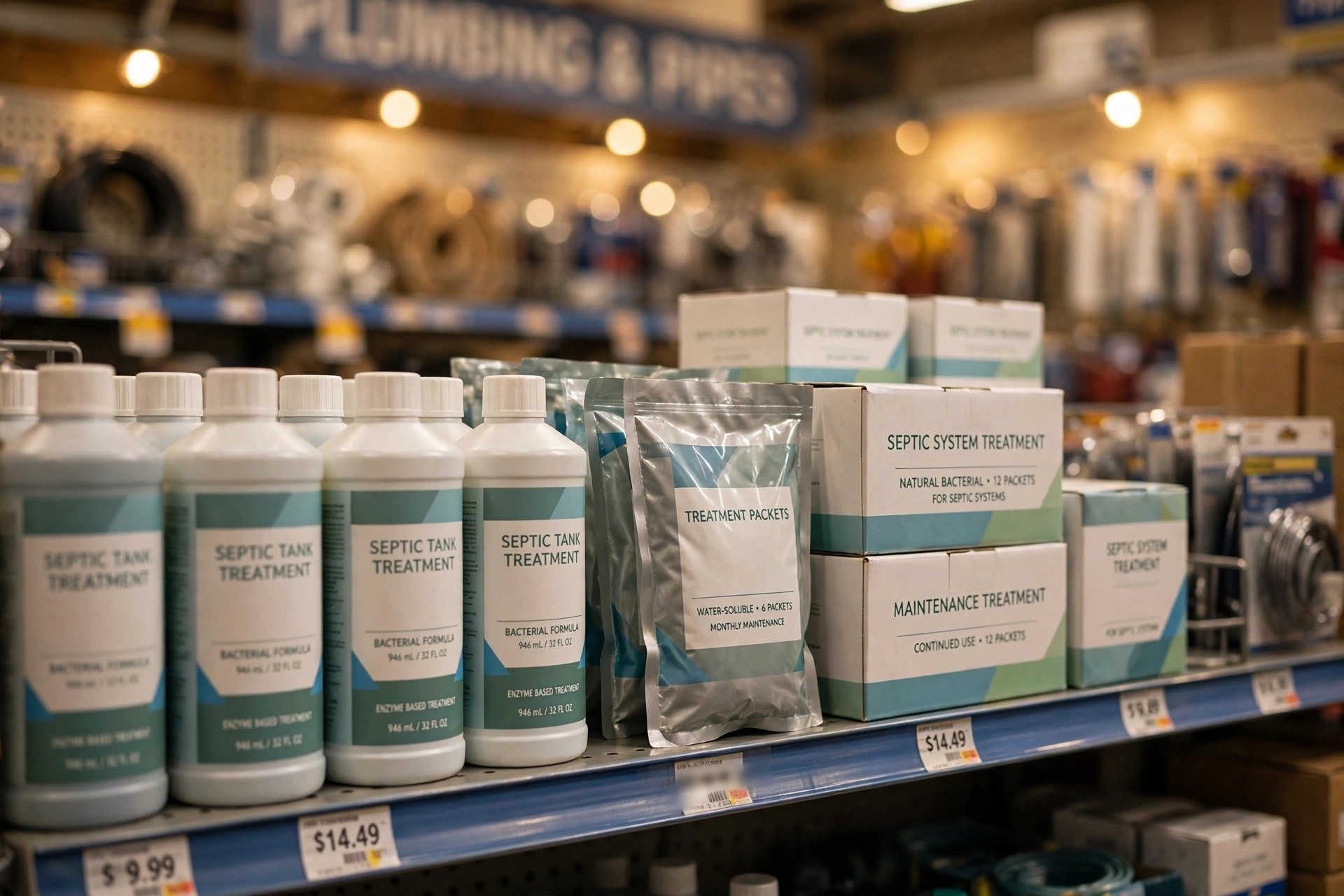
Walk down the hardware store aisle and you'll see them: little packets and bottles promising to "boost" your septic tank, dissolve sludge, and stretch the time between pump-outs. They're cheap, they're easy, and the labels sound scientific. So do they actually work?
Here's the short answer from our crew, and from the experts: if your system is working normally, no — you don't need them. And some of them can do real harm. Here's why.
Your tank already has the bacteria it needs
A septic tank isn't an empty box waiting for help. It's a living system. The bacteria that break down waste arrive with the wastewater itself, and in a normally working tank they're already doing the job. Adding a packet of lab-grown bacteria or yeast on top of that doesn't give your system something it's missing — it's like adding more players to a team that's already winning.
That's the position of the U.S. Environmental Protection Agency, too: its guidance on septic additives says they aren't needed for a normally functioning system, and that they can be ineffective or even harmful.
The three kinds of additives — and why the chemical ones are the worst
Not all additives are the same, and it helps to know what you're actually pouring down the drain:
Biological additives — bacteria, enzymes, or yeast. These are the most common packets. For a healthy tank, they're simply unnecessary. Your tank's own microbes are already adapted to exactly what's in it.
Inorganic additives — strong acids or alkalis, basically the same chemistry as drain cleaner. These are the ones to watch out for. University extension guidance warns they can kill off the beneficial bacteria in your tank for days, letting raw sewage flow straight into the drain field — and they can corrode concrete tanks and distribution boxes.
Organic solvents — concentrated degreasers meant to break down fats and grease. They also kill the bacteria your system depends on, and they can contaminate groundwater. Some states have banned them outright.
So the mildest products are mostly a waste of money, and the strongest ones can damage the very system they're supposed to help.
No additive can replace pumping
Here's the part the labels don't mention: no packet, powder, or liquid can dissolve everything in your tank. Sand, grit, plastics, and other non-biodegradable material will never break down, no matter what you add. They can only be removed by pumping.
Worse, some products work by breaking up the scum layer on top of the tank — which sounds good until those solids wash out into your drain field and clog the soil. A clogged drain field can't be pumped out. It can mean a system replacement costing thousands of dollars, all to avoid a routine pump-out that costs a fraction of that.
If your tank is due — most Berks County homes need pumping every 3 to 5 years (see our guide on how often to pump your septic tank) — no additive resets that clock.
What if something's already wrong?
Slow drains, gurgling pipes, odors, or pooling water over the drain field aren't a sign to buy a packet. They're symptoms that need a diagnosis. A tank that's been hit with a heavy dose of harsh cleaners will usually recover its bacteria on its own once the chemical flushes through — but a backup or a smell can also mean a full tank, a blocked line, or a failing drain field, and only an inspection sorts out which one it is.
Don't let a packet talk you out of a professional look at a real problem.
What actually works instead
The boring stuff, done on schedule:
- Pump every 3 to 5 years, based on your household size and tank size.
- Spread out water use — don't run every load of laundry on the same day.
- Keep grease, wipes, and harsh chemicals out of the drains.
- Fix leaky fixtures, so your tank isn't flooded with extra water.
- Get an inspection if anything changes — new odors, slow drains, or wet spots in the yard.
That's it. No subscription, no monthly packet, no miracle powder. Just a tank that's pumped on time and treated with a little respect.
Save your money — and your drain field
We've been servicing Berks County septic systems for over 50 years, and we've seen plenty of tanks that were "treated" every month and still needed pumping right on schedule. The additives didn't hurt the mild cases much — but they didn't help either, and the harsh ones caused problems we had to fix.
If you're not sure when your tank was last pumped, or something doesn't smell right (literally), call Miller's Sanitary Service at (610) 683-3061. We'll tell you honestly where your system stands, and we'll never sell you something your tank doesn't need.
— The Skunk (asking the questions your septic system wishes you'd ask)